
Moving From Manhattan to Hoboken, NJ: Costs, Parking, COIs & What to Expect
Moving from Manhattan to Hoboken covers only a few miles, but it is rarely a simple “load, cross the river, unload” job. The move crosses from New York into New Jersey and involves two dense urban buildings, each with its own access rules.
A freight elevator window in Manhattan, a required Certificate of Insurance (COI), or an unreserved curb space in Hoboken can affect move day more than the distance does. Building access, street loading, parking, and timing all shape how smoothly the day goes.
This guide covers the cost of moving from Manhattan to Hoboken, building requirements on both sides of the Hudson, Hoboken moving truck parking, and a practical timeline. Optimum Moving, a full-service moving company serving New Jersey and New York, created it to help renters, condo owners, and co-op residents plan with confidence.

How Much Does Moving From Manhattan to Hoboken Cost?
Most people moving from Manhattan to Hoboken pay between several hundred dollars for a small studio and a few thousand dollars for a larger home or a move with difficult access. The final price depends on your inventory and the conditions at both buildings, not on mileage alone.
The table below shows broad planning ranges, not guaranteed rates. They are not Optimum Moving’s published prices, so use them only as a starting point for budgeting.
| Home size | Planning range | What can change the final quote |
| Studio | About $500 to $900+ | Elevator or walk-up, inventory volume, packing, truck access |
| One-bedroom | About $750 to $1,300+ | Building restrictions, elevator windows, long carries, bulky furniture |
| Two-bedroom | About $1,100 to $1,900+ | Crew size, number of rooms, stairs, packing, delivery access |
| Three-bedroom or larger | About $1,600 to $3,000+ | Larger inventory, multiple stops, specialty items, building rules |
What Affects Your Manhattan to Hoboken Moving Cost
The final price depends on the details of your move, and two homes of the same size can price very differently. A quote based only on bedroom count can miss the factors that drive labor, such as a fourth-floor walk-up or a building that limits elevator use to a short window.
The most common cost factors include:
- Inventory, including the amount and type of belongings
- Stairs, walk-up floors, and long carries from truck to door
- Elevator availability and building-approved move windows
- Street access and the distance between the truck and the entrance
- Truck size and crew size
- Full or partial packing services
- Fragile, high-value, antique, or specialty items
- Furniture disassembly and reassembly
- Parking arrangements at either address
- Move date, including weekends, month-end, and peak season
- Extra stops for storage, donation, or another residence
An accurate written estimate requires your actual move details. It should spell out labor, truck, travel, packing materials, insurance or valuation options, and any access-related charges.
Optimum Moving emphasizes flat-rate pricing. The quote process confirms whether that structure fits your particular move, so request a detailed quote once you have your addresses and inventory.For more background on how pricing works, see this moving cost guide for New Jersey.
Why Access and Building Rules Matter More Than Mileage

The biggest variable when moving from Manhattan to Hoboken is access at each address, not the distance between them. A crew that loads and unloads without delays will finish far faster than one that waits on elevators or hunts for parking.
That difference shows up in labor time, and labor time drives the final bill. Understanding what each location involves helps you plan around problems before they reach move day.
What to Expect in Manhattan
Loading in Manhattan often involves a service entrance, a loading dock schedule, or a freight elevator reservation. Many buildings also require a check-in with a doorman or superintendent before the crew can begin.
Move hours are frequently limited to specific days and time windows. A crew that arrives outside the approved window may be turned away or delayed.
What to Expect in Hoboken
Hoboken streets are compact, and curb space is in high demand. Commuter traffic, street cleaning, construction, and residential parking can all limit where a truck is able to stop.
A truck that cannot park near the entrance means longer carries and more time on the clock. Reserving curb space ahead of time, when needed, helps keep the move on schedule.
What Happens Between the Two Addresses
River crossings can add traffic delays, especially during commuting hours. The driver should choose a lawful, practical route based on the truck, conditions, and restrictions on the day.
For that reason, no article can promise a specific route or travel time. Your mover will plan around the conditions on your move date.
A Simple Example
Picture a one-bedroom move where both buildings have reserved elevators and legal curb access. That move can go quickly and stay close to the original estimate.
Now picture the same inventory leaving a fourth-floor walk-up, with a Hoboken truck parked several blocks away because no curb space was reserved. The added stairs and long carry can extend the move considerably, which is why Optimum Moving asks about access details when preparing a quote for moving in and out of NYC.
Manhattan Move-Out Requirements: COIs, Move Approval, and Freight Elevators
Many Manhattan co-ops, condos, and rental buildings require building-specific approval, a scheduled service or freight elevator, and a Certificate of Insurance from the moving company. These requirements usually come from the building rather than from a citywide parking process for ordinary apartment moves.
Because every property sets its own rules, the building manager’s written instructions should guide your planning. When moving from Manhattan to Hoboken, starting that conversation as soon as you have a target move date protects your timeline.
What Is a COI?
A Certificate of Insurance (COI) is a document that shows a moving company’s insurance coverage. Buildings often request one before allowing movers to use service entrances, elevators, loading areas, or common spaces.
Each building may have its own exact wording and coverage requirements. Some ask for the property owner or management company to be named as certificate holder or additional insured, and some set minimum coverage amounts.
How to Handle the NYC Moving COI
Ask your building management for the move-out package, house rules, and exact COI wording as early as possible. Then send the building’s written COI requirements directly to your mover instead of paraphrasing them.
Some moving industry guidance notes that many NYC buildings expect COIs 48 to 72 hours before a move. Individual deadlines vary, and some buildings set stricter internal timelines, so treat your building’s written instructions as final.
Freight Elevator and Move Approval
If your building offers a freight or service elevator, reserve it at the same time you confirm your move date. Elevator slots can be limited, especially on weekends and at the end of the month.
Also ask about weekday-only move windows, protective floor coverings, elevator pads, and service entrance procedures. Keep all approved documents easy to reach on move day.
Questions to Ask Your Building Manager
Asking the right questions early prevents delays on move day. Use this checklist when you contact your Manhattan building:
- What move-out dates and hours are available?
- Is a freight or service elevator required, and how do I reserve it?
- What is the deadline for the COI and move application?
- What exact insurance language must appear on the COI?
- Is there a refundable move deposit or a nonrefundable move fee?
- Where may the moving truck load?
- Are there restrictions on truck size, elevator use, protective materials, or weekend moves?
If you need help matching your building’s requirements, Optimum Moving offers moving insurance information and support. Share your building’s written requirements when you request a quote.
Hoboken Moving Truck Parking and Temporary No Parking Signs
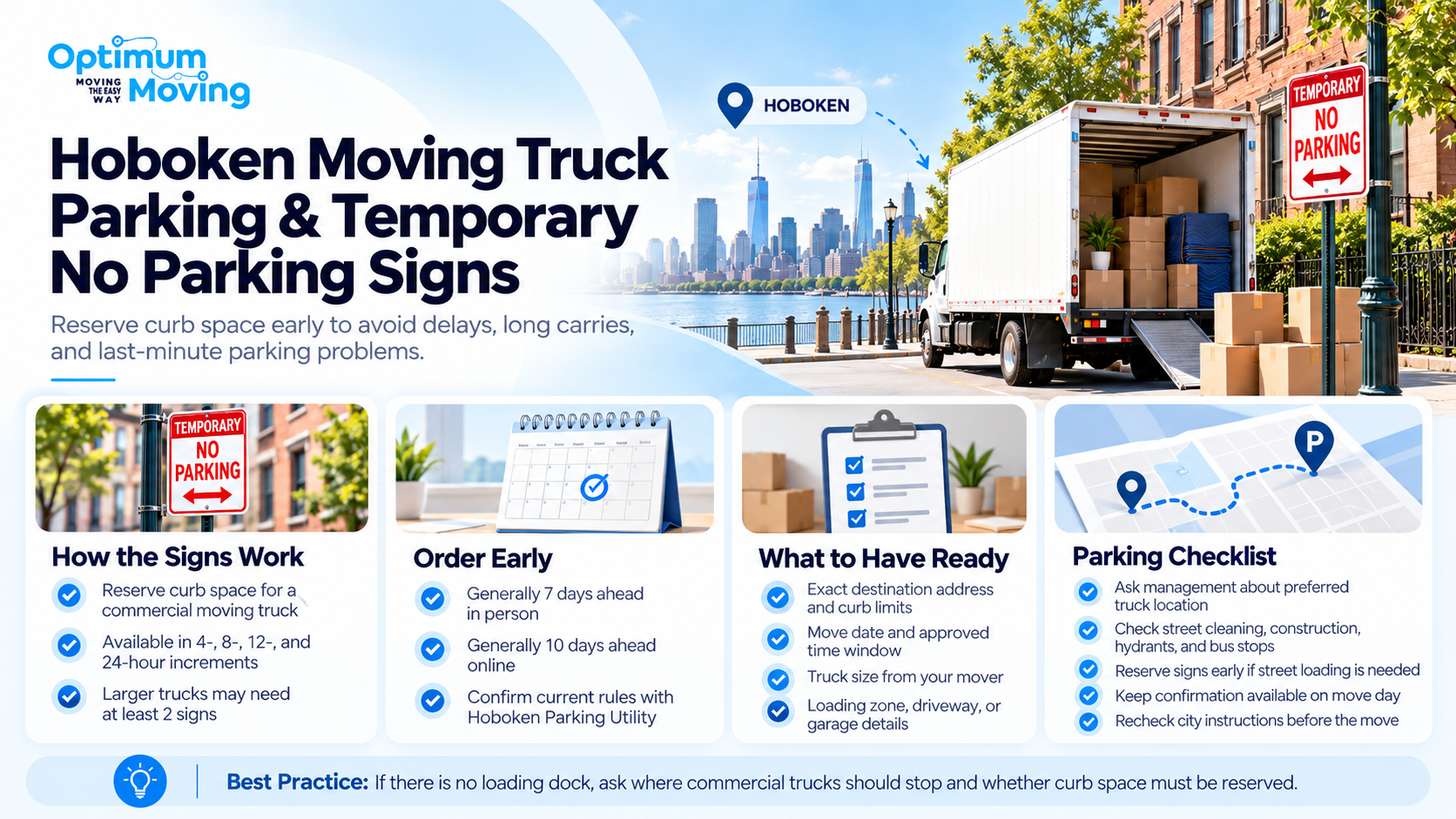
Hoboken uses Temporary No Parking signs to reserve curbside space for commercial vehicles involved in moves. Arranging them early is one of the most useful steps you can take when moving from Manhattan to Hoboken.
The city’s published guidance says orders are generally required at least 7 days in advance in person or 10 days in advance online. Confirm current rules, lead times, fees, and eligibility directly with the Hoboken Parking Utility before finalizing your plans.
How Hoboken Temporary No Parking Signs Work
The signs reserve a specific stretch of curb for the commercial moving vehicle on the date and hours you request. According to the city’s online guidance, they are available in 4-, 8-, 12-, and 24-hour increments.
Larger moving vehicles may require at least two signs. Your mover can tell you the truck size so you request enough curb space.
What to Have Ready Before You Order
The city asks applicants to identify the exact curb space they need, so gather the details first. Having them ready keeps the order simple and avoids last-minute changes.
- Exact destination address and proposed curb limits
- Move date and the time window confirmed with your mover
- Truck size, confirmed with the moving company
- Whether the building has a loading zone, driveway, or garage clearance
Hoboken Moving Truck Parking Checklist
Street loading is not the right fit for every building. Use this checklist to decide what your move needs and to catch conflicts early:
- Ask property management whether the building has a preferred truck location
- Check for street-cleaning restrictions, construction, hydrants, bus stops, and intersections near the entrance
- Reserve Temporary No Parking signs early if street loading is necessary
- Keep your confirmation available on move day
- Recheck the city’s instructions shortly before the move
If your Hoboken building has no loading dock, ask management where commercial trucks should stop and whether street space must be reserved. For local New Jersey moves, Optimum Moving can coordinate the truck size and arrival window once you request a quote.
What to Confirm With the Hoboken Building or Landlord
Moving from Manhattan to Hoboken means following your destination building’s move-in rules, even after your curb space is arranged. Confirm move-in hours, elevator access, insurance requirements, and fees in writing before you book the truck.
An approved date and curb plan only help if the building is ready to receive the crew. Getting the written move-in rules first prevents delays at the door.
Move-In Rules and Access
Every Hoboken building sets its own schedule for deliveries and moves. Ask for the written rules early, since they affect which dates and times are realistic.
- Move-in days and hours
- Whether a service or freight elevator exists, and how to book it
- Loading dock, garage, or street-loading instructions
- Delivery entrance location
- Truck height limits for garages
Send these details to your mover when you book residential moving services so the crew can plan around them.
Insurance, Fees, and Protection
Many buildings ask for a COI from the moving company, just as Manhattan buildings do. Requirements differ from one property to the next, so ask for the exact wording.
- Certificate of Insurance requirements
- Move-in fees or refundable damage deposits
- Rules for lobby, hallway, wall, and floor protection
- Restrictions on package rooms or loading areas
Contacts, Keys, and Access
Move day runs better when someone at the building knows the crew is coming. Get a direct contact before the move, not on the morning of it.
- Building superintendent or management contact
- Procedures for keys, fobs, and parking passes
- Elevator access instructions for the crew
A Practical 4 to 6 Week Timeline for Moving From Manhattan to Hoboken
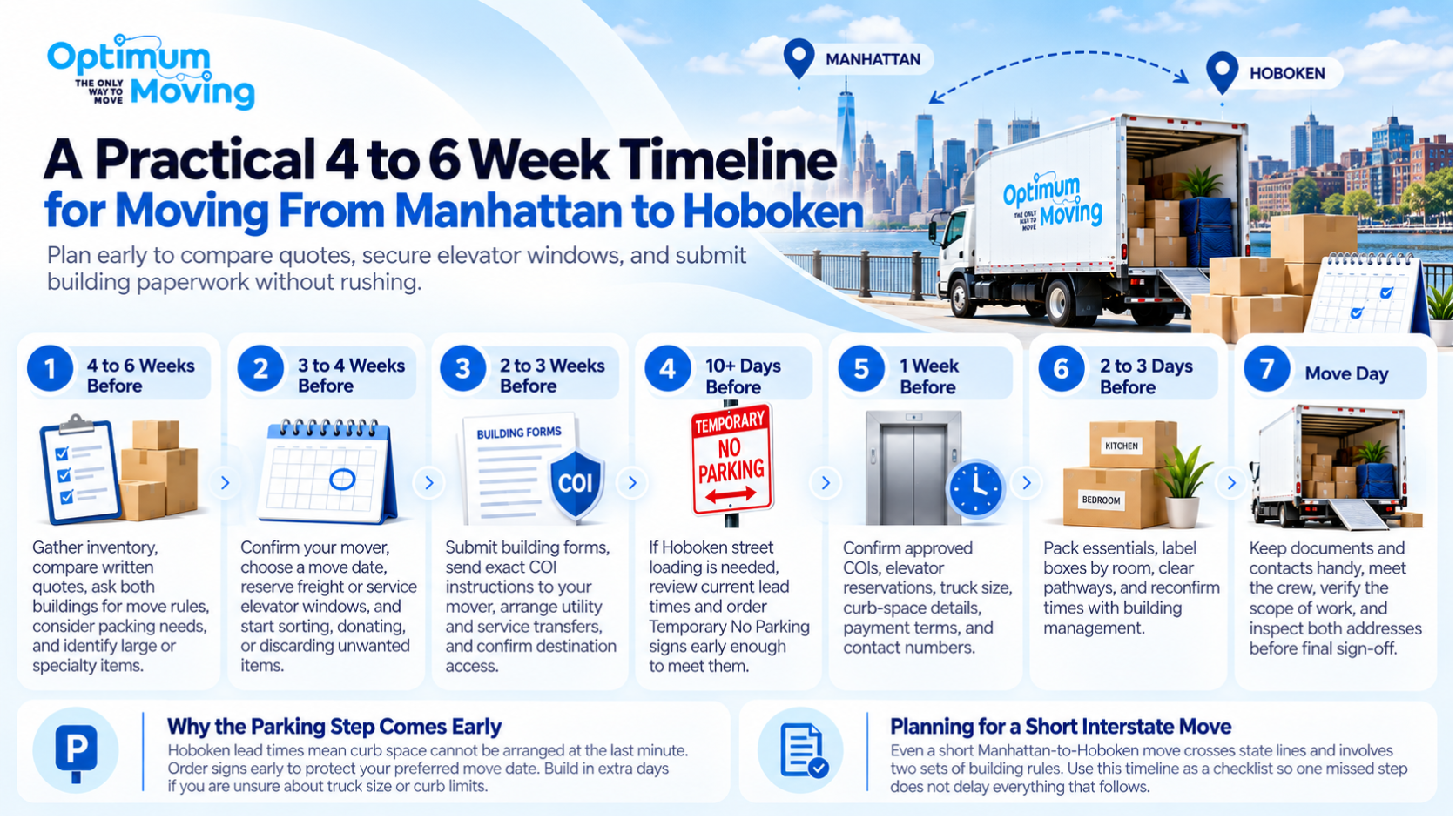
Start planning four to six weeks before your move date, and begin Hoboken curb planning even earlier if street loading is needed. A steady timeline gives you room to compare quotes, secure elevator windows, and submit building paperwork without rushing.
The table below breaks the process into stages. Adjust it to your building’s rules, since some properties require more notice than others.
| Timing | Recommended action |
| 4 to 6 weeks before | Gather your inventory, compare detailed written quotes, ask both buildings for move rules, consider packing needs, and identify large or specialty items |
| 3 to 4 weeks before | Confirm your mover, choose a move date, reserve available freight or service elevator windows, and start sorting, donating, or discarding unwanted items |
| 2 to 3 weeks before | Submit building forms where required, send exact COI instructions to your mover, arrange utility and service transfers, and confirm destination access |
| 10 or more days before | If Hoboken street loading is needed, review the current Hoboken Parking Utility lead time and order Temporary No Parking signs early enough to meet it |
| 1 week before | Confirm approved COIs, elevator reservations, truck size, curb-space details, payment terms, and contact numbers |
| 2 to 3 days before | Pack essentials, label boxes by room, clear pathways, and reconfirm all times with building management |
| Move day | Keep documents and contacts handy, meet the crew, verify the scope of work, and inspect both addresses before final sign-off |
Why the Parking Step Comes Early
Hoboken’s published lead times mean curb space cannot be arranged at the last minute. Treating it as an early task protects you from losing your preferred move date.
Build in extra days if you are unsure about the truck size or the exact curb limits. Your mover can help confirm both before you place an order.
Planning for a Short Interstate Move
A Manhattan to Hoboken move is short, but it still crosses state lines and involves two sets of building rules. For more background, this guide to small interstate moves explains how to keep a shorter relocation organized.
Use the timeline above as a checklist and check off each stage as you go. Missing one early step, such as a COI deadline, can push back everything that follows.
How to Choose a Mover for a Manhattan-to-Hoboken Move
The best mover for a Manhattan to Hoboken move is one that gives you a clear written estimate and has a plan for both buildings. Price matters, but so do insurance, scope of services, and how the company handles tight access.
Comparing movers on the same details makes the differences easier to see. A short list of specific questions works better than a general search for the “best” company.
What to Look For in a Written Estimate
A useful estimate states how the price is structured, whether flat-rate, hourly, or not-to-exceed. It should also explain what information the quote is based on, such as an item list, video walkthrough, or in-home survey.
Give every company the same details so the quotes are comparable. Include building access, elevator windows, and parking assumptions.
Questions to Ask a Moving Company
Asking these questions before you book helps you spot gaps in a quote. The answers also show how much experience a company has with dense urban buildings.
- Is the price flat-rate, hourly, or not-to-exceed, and what is it based on?
- Is the company licensed and insured, and can it provide a COI for my building?
- What valuation or insurance options are available for my belongings?
- Are packing, unpacking, furniture disassembly, and reassembly available if I need them?
- How does the crew handle walk-ups, long carries, and restricted elevator windows?
- What happens if the truck cannot legally park close to either building?
- Which additional charges could apply, such as access-related labor, packing materials, storage, oversized items, or weekend scheduling?
- Are travel, tolls, parking, and fuel included in the quote?
Check Reviews Carefully
Recent, independent reviews show how a company performs on real moves. Focus on punctuality, care with belongings, communication, billing clarity, and how problems were resolved.
A few detailed reviews tell you more than a long list of short ones. Look for comments about buildings and access similar to yours.
How Optimum Moving Fits In
Optimum Moving is a full-service moving company serving New Jersey and New York. It offers residential and local moving, packing and unpacking, white-glove service, and furniture disposal, and it emphasizes flat-rate pricing.
Your quote confirms which services and pricing structure apply to your move. To see how the company describes its approach, visit the Why Choose Optimum Moving page.
What to Pack Separately for Move Day
Keep essentials, valuables, and anything you cannot easily replace with you instead of on the moving truck. A dedicated bag or car load means you can reach what you need on move day, even if boxes are still in transit.
Set these items aside a few days before the move so they do not get packed by accident. Label the bag clearly and tell everyone helping that it stays with you.
Documents and Valuables
Paperwork is easy to misplace during a move and hard to replace. Keep it in one bag that stays in your possession.
- Identification, lease or closing documents, and building paperwork
- COI confirmations and elevator reservation details
- Keys and access fobs for both buildings
- Jewelry, cash, financial records, and irreplaceable documents
Daily Essentials
You will likely need these items before the new home is set up. Packing them separately saves you from opening several boxes on the first night.
- Medications and medical devices
- Phones, laptops, chargers, hard drives, and critical work materials
- A change of clothes, toiletries, and towels
- Basic kitchen items, pet supplies, and children’s necessities
A First Night Box
A first night box helps you settle in without unpacking everything. It also keeps small tools and supplies within reach for move-in day.
- Box cutter, tape, and markers
- Small tools for reassembling furniture
- Cleaning supplies and a basic first-aid kit
- Bedding for the first night
For a longer list of priorities, see this guide on what to pack first when moving.
Ask Your Mover About Restricted Items
Movers may have policies about hazardous, perishable, fragile, or high-value items. Ask about these before packing day instead of assuming what is allowed.
Your written estimate or moving contract should explain these policies. If it does not, ask for them in writing.
Get a Detailed Manhattan-to-Hoboken Moving Quote
Your move is more than the distance between two addresses. A clear plan for inventory, building paperwork, elevator access, and Hoboken curb space can make the day far less stressful.
Optimum Moving can help you build that plan around your actual home, schedule, and access conditions. Request a detailed quote to get a written estimate based on your specific move.
What to Have Ready
The more detail you share, the more accurate your estimate can be. Gather these items before you contact the company:
- Your pickup address in Manhattan and your destination address in Hoboken
- Your target move date and any flexibility you have
- Your approximate home size and inventory, including large or specialty items
- Elevator or walk-up details at both buildings
- Parking details, including whether street loading is needed in Hoboken
- Each building’s written requirements, including COI wording and move windows
Talk to the Team
If you prefer to speak with someone, call Optimum Moving at (855) 315-6683. Have your addresses and move date nearby so the conversation goes quickly.
Ask whether a COI, packing service, parking coordination, or furniture disposal fits your move. The quote process confirms which services and pricing structure apply to you.