
Moving to Fort Lee From NYC: George Washington Bridge, Parking & Moving Logistics
Moving from NYC to Fort Lee is a short local relocation, but it takes advance coordination to go smoothly. Fort Lee sits directly across the George Washington Bridge, so the distance looks small on a map. The real work is in the details that mileage does not show, such as a truck-legal bridge route, legal loading and parking, a service elevator reservation, and the right Certificate of Insurance (COI). Planning those items early keeps a short move from turning into a long, expensive day.
The most common friction points on this route include:
- Limited curb access and long carries at the NYC pickup
- Bridge traffic and truck-level restrictions on the George Washington Bridge
- Fort Lee high-rise rules for elevators, loading docks, and move-in hours
- COI paperwork required by the NYC building, the Fort Lee building, or both
- Legal truck parking near the Fort Lee destination
Quick answer: Moving trucks must use the upper level of the George Washington Bridge, and Fort Lee buildings often set their own elevator, COI, and loading requirements. Confirm your building’s rules in writing and plan legal truck parking before moving day.
Each of these pieces depends on the others. A delay at a Manhattan freight elevator can push back the bridge crossing and cut into your Fort Lee elevator window.
Optimum Moving is a licensed and insured New Jersey moving company that handles local moves, residential moves, and moves in and out of NYC. Services include full packing and unpacking, box delivery, flat panel TV installation, and furniture disposal.
This guide walks through bridge routing, Fort Lee parking, building requirements, and a moving-day timeline. If you already have your dates, you can request a flat-rate quote at any point.
Is Moving From NYC to Fort Lee a Local Move?
Many movers treat a move from NYC to Fort Lee as a nearby metro-area relocation, but the classification and pricing depend on the moving company, the inventory, the access conditions, and the route. The trip crosses the Hudson River and a state line, which means it is not always handled the same way as a move within a single city. Distance is only a small part of the cost and effort. Bridge tolls, building access, and time spent waiting on elevators often matter more than the number of miles driven. Asking how a mover classifies and prices the job is the best way to avoid surprises, and the Federal Motor Carrier Safety Administration’s Protect Your Move site explains what to expect from a mover on moves that cross state lines.
A short cross-river move can still include several time-consuming pieces:
- A walk-up or elevator pickup in Manhattan, the Bronx, Brooklyn, or Queens
- COI requirements from one or both buildings
- A long carry from the curb to the building entrance
- Bridge tolls and truck route restrictions
- Fort Lee high-rise delivery conditions and elevator time windows
- Packing, storage, furniture disposal, or multiple pickup and drop-off stops
Each item adds time to the schedule. A quote that ignores them can look cheap on paper and grow on moving day.
The move may be only a few miles, but a Manhattan walk-up, a packed bridge approach, and a Fort Lee service elevator reservation can turn a short route into a full moving-day operation.
If you want a deeper look at how state lines affect moving rules, Optimum Moving explains the difference between interstate and intrastate moving. It is worth a read before you compare quotes.
Ask each mover to spell out what its price includes, from tolls and parking to stairs, long carries, and packing. A written scope of work makes quotes easy to compare, and Optimum Moving offers flat-rate pricing so the number you agree to is the number you pay.
George Washington Bridge Logistics for Moving Trucks
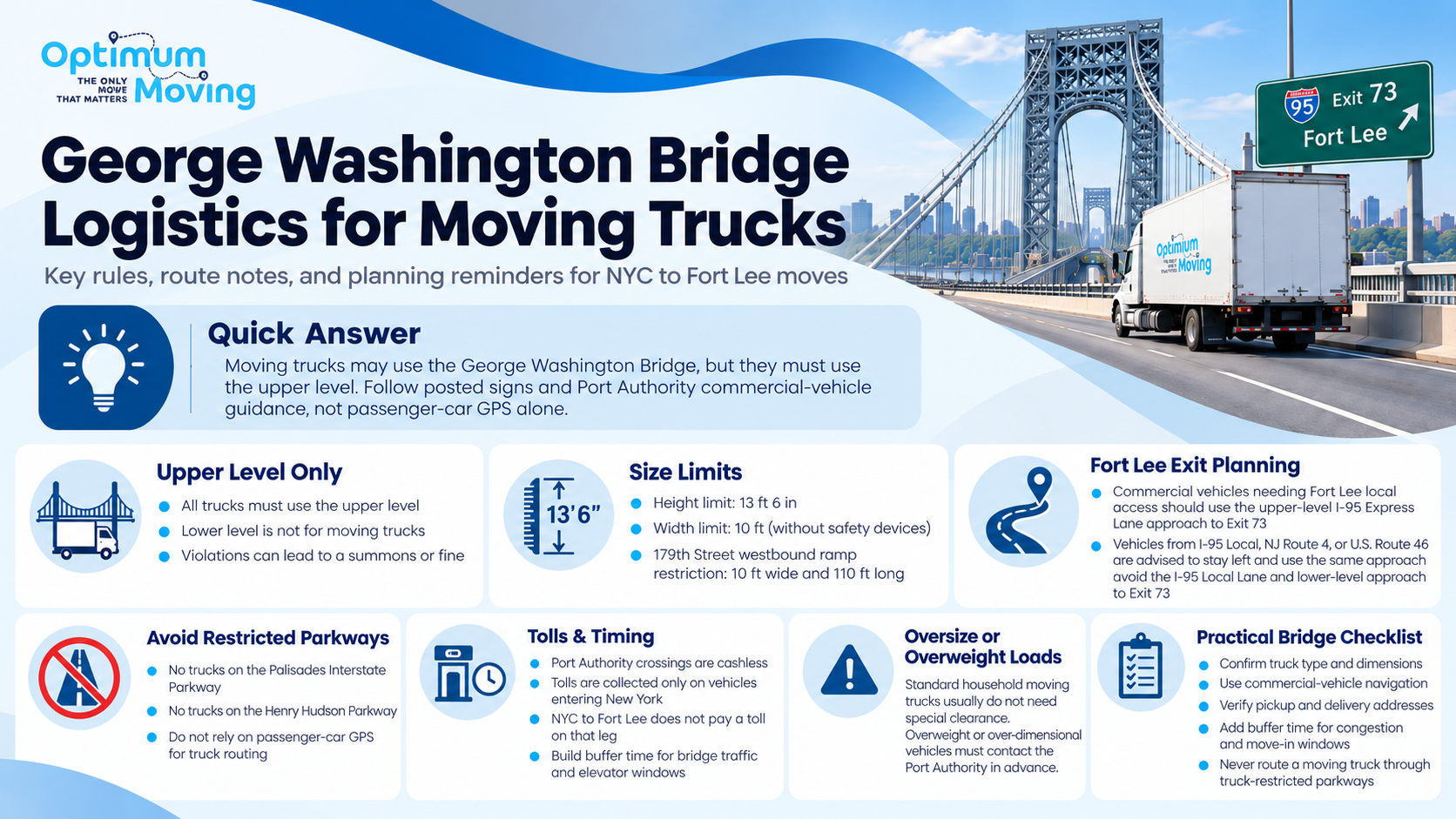
Moving trucks can cross the George Washington Bridge, but they must follow the Port Authority’s truck rules. The most important rule is that all trucks must use the upper level of the bridge, and drivers who use the lower level can be fined. A passenger-car GPS route often ignores these rules, so it cannot be trusted for a box truck. A professional mover plans the crossing before moving day and verifies it against current Port Authority guidance.
Quick answer: Trucks may use the George Washington Bridge, but they must use the upper level. Movers should follow posted signs and Port Authority commercial-vehicle guidance, not consumer navigation alone.
Moving Trucks Must Use the Upper Level
The Port Authority of New York and New Jersey states that all trucks must use the upper level of the George Washington Bridge. Violators are subject to a summons or fine, so this is an enforced rule and not a suggestion. The lower level is reserved for passenger vehicles and buses, and it is not an option for a moving truck. This matters most on busy days, when a driver might be tempted to switch levels to save time.
The upper level also has published size limits, so truck dimensions matter:
- The Port Authority lists a height limit of 13 feet 6 inches for the upper level.
- The width limit is 10 feet for vehicles without safety devices.
- A ramp restriction of 10 feet wide and 110 feet long applies on the 179th Street westbound ramp.
Confirm your mover’s truck size against these limits before booking. Optimum Moving plans truck selection and routing as part of every NYC move.
Fort Lee Exit Planning Matters
Fort Lee sits right at the New Jersey end of the bridge, so the approach to local streets needs a plan. The Port Authority’s Truckers Guide directs commercial vehicles that need access to local Fort Lee streets to use the upper-level I-95 Express Lane approach to Exit 73. Vehicles arriving from I-95 Local, NJ Route 4, or U.S. Route 46 are advised to stay left and use that same approach. Commercial vehicles are urged to avoid the I-95 Local Lane and lower-level approach to Exit 73.
Exact routing depends on where the truck starts, which direction it travels, and how the day’s traffic is running. The Port Authority’s wording addresses New York-bound commercial vehicles, so a Fort Lee-bound leg from Manhattan may not follow the same path. Ask your mover how the route was planned, and expect them to verify it on the day.
Avoid Restricted Parkways
Two well-known parkways near this route do not allow trucks. Trucks are not permitted on the Palisades Interstate Parkway in New Jersey or the Henry Hudson Parkway in New York. Both roads can look like natural shortcuts on a map, which is exactly how a wrong turn happens. Passenger-car GPS apps may still suggest them, so a box truck should never follow those directions blindly.
Tolls and Timing
Port Authority crossings are cashless, with tolls paid by E-ZPass or Tolls by Mail, and tolls are collected only on vehicles entering New York. A truck driving from NYC into Fort Lee does not pay a toll on that leg, but the return trip to New York does. Ask your mover whether tolls are built into the price, as they are with Optimum Moving’s flat-rate pricing, which lists travel, tolls, parking, and fuel.
Bridge traffic can change a schedule quickly. Build buffer time between the NYC pickup and your Fort Lee elevator window, and avoid promising an arrival time to building management.
Oversize or Overweight Loads
A standard household moving truck does not normally need special clearance. Operators of overweight or over-dimensional vehicles must contact the Port Authority for approval in advance, so anything unusual should be flagged early. Your mover should confirm truck dimensions, weight, and any special routing needs.
A practical bridge checklist:
- Confirm the truck type and dimensions against the upper-level limits
- Use commercial-vehicle navigation and Port Authority guidance
- Confirm pickup and delivery addresses before dispatch
- Build buffer time for bridge congestion and building move-in windows
- Never route a moving truck through a truck-restricted parkway
Fort Lee Parking and Loading: What to Confirm Before Moving Day
Fort Lee parking rules vary by street, zone, building, and vehicle type, so no single rule covers every move. A moving truck cannot assume it can stay at the curb, use a resident permit, or double-park legally. The safest approach is to build a loading plan with your building and the Fort Lee Parking Authority before the move date. Getting this step right protects your schedule, because a truck that cannot stop near the entrance turns every carry into a long one.
Quick answer: Residential parking permits do not automatically cover commercial moving trucks. Confirm the loading and parking plan for your exact address and date with building management and the Fort Lee Parking Authority.
Residential Permit Rules Do Not Automatically Cover Moving Trucks
Fort Lee runs a Residential Permit Parking Program for registered resident vehicles. On designated permit streets, vehicles without a permit generally face a two-hour limit on weekdays from 9 a.m. to 5 p.m., subject to posted exceptions. Commercial vehicles are not eligible for a residential parking permit, so a resident’s permit cannot simply be handed to a moving truck. That is why a mover should never treat a permit sticker as a parking plan.
Always read the posted signs on the destination block, since zone hours and exceptions can differ from street to street.
Commercial Vehicle Rules Require Confirmation
Fort Lee states that commercial merchants and contractors working in residential permit zones must register their vehicles with the Parking Authority when a project requires them to be there. The Borough notes an eight-hour grace period for certain commercial and service work, and longer needs require contacting the office. These rules were written for contractors and service providers, so they should not be read as blanket permission for moving trucks.
Whether a moving truck qualifies, where it may stage, and what paperwork it needs should be confirmed directly with the Parking Authority for your specific address and date. Ask for the answer in writing when possible.
Contact the Right Local Resource
The Fort Lee Parking Authority manages public street parking and off-street parking facilities, with the goal of reducing congestion. Its office is at 231 Main Street, second floor, and permit questions can be directed to 201-592-3500, ext. 1518. Confirm the number and office hours on the Borough’s website before calling, since contact details change.
Building management is the second call to make. Buildings often control their own loading areas, so the Parking Authority and your property manager may each hold part of the answer.
Build an Address-Specific Parking Plan
A good parking plan is short, written down, and shared with your mover. Cover these points before moving day:
- Ask your building whether it has a loading dock, a designated service entrance, or truck staging instructions
- Verify curb regulations and posted signage near the destination
- Ask whether the truck must use a designated loading zone
- Confirm whether building staff need the truck plate number or arrival window
- Ask whether cones, curb space, or building-managed loading access can be reserved
- Have the mover document the planned truck size and arrival time
- Build extra time for a long carry if curbside unloading is not possible
Optimum Moving factors parking into its flat-rate quotes, so access details you share up front help keep the price accurate.
Do not plan on double-parking or blocking a lane. It can lead to tickets and delays, and it puts the crew and other drivers at risk.
Fort Lee Apartment and High-Rise Move-In Requirements
Many Fort Lee apartment and condominium buildings have move-in procedures that go beyond municipal parking rules. These requirements differ by property, so you should get written instructions from your management office before booking your move. Fort Lee has a large number of high-rise buildings near the bridge, and many of them manage elevators, loading areas, and move times tightly. A mover who has handled these buildings can spot missing paperwork early, which keeps your move from stalling at the front desk.
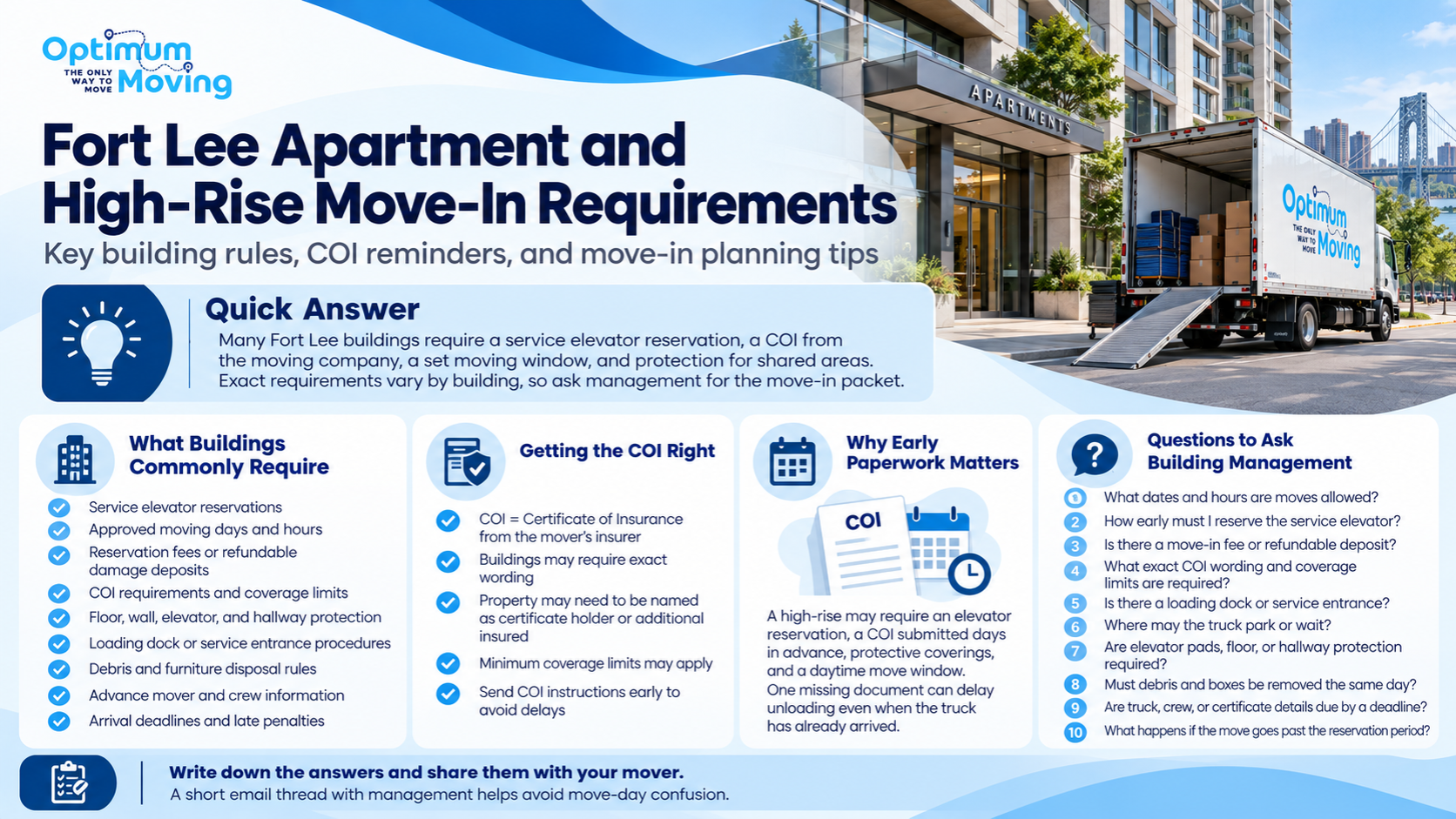
Quick answer: Many Fort Lee buildings require a service elevator reservation, a COI from the moving company, a set moving window, and protection for shared areas. Exact requirements vary by building, so ask management for the move-in packet.
What Fort Lee Buildings Commonly Require
Municipal parking rules and building rules are two separate layers of planning. The city decides where a truck may stop, while the building decides when, how, and under what conditions you can move in. Requirements that buildings commonly set include:
- Service elevator reservations
- Approved moving days and hours
- Reservation fees and refundable damage deposits
- COI requirements, including exact coverage limits
- Floor, wall, elevator, and hallway protection
- Loading dock and service entrance procedures
- Rules for disposing of boxes, packing debris, and unwanted furniture
- Advance submission of mover and crew information
- Arrival deadlines and penalties if the crew runs late
Treat this as a checklist to compare against your own building’s packet, not as a set of universal rules.
Getting the COI Right
A Certificate of Insurance is a document from the moving company’s insurer that proves its coverage. Buildings often want specific wording, such as the property named as certificate holder or additional insured, along with minimum coverage limits. Send those exact requirements to your mover early, since insurers need time to issue the certificate.
Optimum Moving is licensed and insured as a New Jersey moving company, and it can work from your building’s COI instructions. Missing or incorrect wording is one of the most common reasons a move-in gets delayed.
A Common Move-In Scenario
Here is an anonymized example of how one missing item can affect the whole day:
A Fort Lee high-rise may require a service elevator reservation, a COI submitted several business days before the move, protective coverings in common areas, and a move completed within a daytime window. Missing one document can delay unloading even when the truck is already on site.
Nothing about the truck or the crew is at fault in this case, yet the move still stops. Early paperwork is the simplest fix.
Questions to Ask Building Management
Bring this list to your property manager or management office:
- What dates and hours are moves allowed?
- How far in advance do I need to reserve the service elevator?
- Is there a move-in fee or refundable damage deposit?
- What exact COI wording and coverage limits are required?
- Is there a designated loading dock or service entrance?
- Where may the moving truck park or wait?
- Does the building require elevator pads, floor protection, or hallway protection?
- Must movers remove all cartons and packing debris the same day?
- Does management require truck details, crew details, or a certificate by a set deadline?
- What happens if the move runs beyond the allotted reservation period?
Write down the answers and share them with your mover. A short email thread with management also gives you a record if a question comes up on moving day.
NYC Pickup Logistics Before the Bridge
The delivery plan for a Fort Lee move begins at the pickup building in New York. A delay at a Manhattan freight elevator, a tight curbside loading spot, or a late COI approval can push back the bridge crossing and cut into your Fort Lee elevator window. Each building in the chain has its own rules, so the two ends of the move need to be planned together. Movers with real NYC experience build the schedule backward from the Fort Lee reservation, not forward from the pickup time.
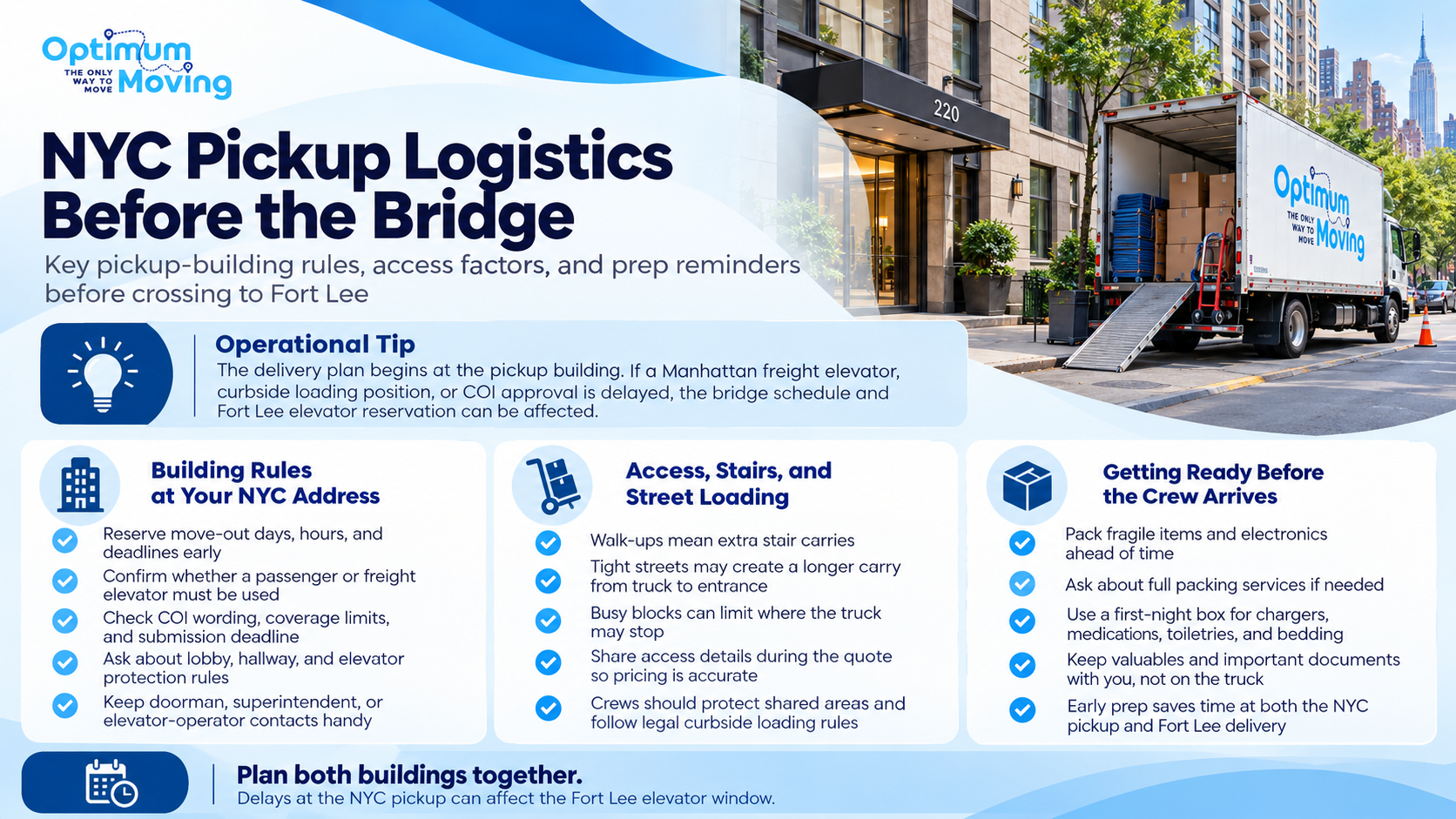
Operational tip: The delivery plan begins at the pickup building. If a Manhattan freight elevator, curbside loading position, or COI approval is delayed, the bridge schedule and Fort Lee elevator reservation can be affected.
Building Rules at Your NYC Address
NYC buildings often require advance reservations for move-outs, and many limit moves to certain days and hours. Your building may also require a COI from the moving company before the crew can enter. Ask management about these rules as soon as you have a move date, since freight elevator slots can fill up quickly. Optimum Moving handles moves in and out of NYC and works from your building’s written requirements.
Points to confirm with your NYC building:
- Move-out days, hours, and reservation deadlines
- Whether a passenger or freight elevator must be used
- COI wording, coverage limits, and submission deadline
- Lobby, hallway, and elevator protection requirements
- Contacts for the doorman, superintendent, or elevator operator
Access, Stairs, and Street Loading
Access at the origin sets the pace for the whole day. A walk-up means stair carries, a tight street means a longer walk from the truck, and a busy block may limit where the truck can stop. Tell your mover about these conditions during the quote so the estimate reflects them. Details like these are the main reason two moves of the same size can take very different amounts of time.
Sidewalk and lobby protection matter too. Crews should protect shared areas as required by the building, and they should follow legal loading rules at the curb.
Getting Ready Before the Crew Arrives
A little preparation before moving day saves time at both ends. Pack fragile items and electronics ahead of time, or ask your mover about full packing services. If you plan to box things yourself, Optimum Moving’s guide on what to pack first is a useful starting point.
Label a first-night box with essentials such as chargers, medications, toiletries, and bedding. Keep valuables and important documents with you rather than on the truck.
NYC to Fort Lee Moving-Day Timeline
A move from NYC to Fort Lee runs more smoothly when both you and your mover work from the same schedule. The timeline below shows what to do at each stage and what your mover should be coordinating in parallel. Most delays on this route come from paperwork, elevator reservations, and access questions that were settled too late. Starting four weeks out gives you time to fix problems before they affect moving day.
Book your mover 2 to 4 weeks ahead, request building rules in writing, reserve both elevators, and submit COIs 1 to 2 weeks before the move. Reconfirm every detail 2 to 3 days out.
| Timeframe | What you should do | What the mover should coordinate |
| 2 to 4 weeks before | Book the mover, request building rules in writing, reserve NYC and Fort Lee elevators, ask about COI requirements, and identify disposal needs | Review inventory, access conditions, truck size, building restrictions, and service needs |
| 1 to 2 weeks before | Submit COI requests, confirm the truck and loading plan, arrange packing or box delivery, and confirm parking requirements | Issue required insurance documents and reconfirm the access plan and move-day schedule |
| 2 to 3 days before | Reconfirm management approvals, elevator times, keys, contact names, and phone numbers | Check the planned route, truck assignment, crew schedule, and expected bridge conditions |
| Move day: pickup | Keep elevators, entrance, and loading path accessible, and set aside valuables and essentials | Protect furniture and inventory, load efficiently, and communicate timing |
| Bridge and transit | Stay reachable for updates | Follow the truck-legal route and adjust for conditions |
| Fort Lee delivery | Meet the crew and building representative, and confirm elevator and loading access | Deliver, place furniture, assemble or disassemble as agreed, and remove packing materials if included |
How to Choose NYC-to-Fort Lee Movers
The right mover for an NYC-to-Fort Lee move is one that understands both ends of the trip, not just the distance. A company that has handled Manhattan pickups and Fort Lee high-rise deliveries will already know how COIs, elevator windows, and truck routing fit together. The questions below help you compare movers on the details that affect your day, not only the price. Asking them before you book also gives you a written record of what each company promised.
Choose a licensed and insured mover that can provide your building’s COI, has handled elevator buildings, and gives a written quote that covers tolls, parking, and long carries.